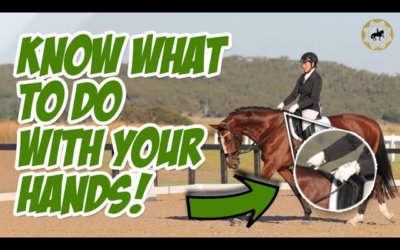
What To Do With Your Hands In Canter
The honest answer is: keep them still. The useful answer is why you cannot, and that has almost nothing to do with your hands.
Watch: why your hands belong in a little glass box.
The short answer
Keep them still. In canter your hands should stay quiet, as though they are locked in a little glass box, with your elbows bent and resting by your sides. If your hands are moving, it is almost always because your body is moving. The fix is not in your hands. It is in your seat.
In this article
- The answer you probably do not want
- Your hands are attached to your body
- What an independent hand actually means
- So what is the hand's job in canter?
- The alignment test that shows you the problem
- What to actually work on
- Watch it taught to a real rider
- Three things that keep hands busy
- The part most riders are never told
The answer you probably do not want
What should you do with your hands in canter? Keep them still. Lock them up in a little glass box and leave them there.
Natasha is the first to admit that is a maddening thing to be told. Her words, near the end of the video above: you get the answer "keep them still", and you go, yeah, but my hands do this. Or they do that. Or every time I come round the corner there is suddenly a loop in my rein and I did not put it there.
So the instruction is right, and on its own it is useless. What follows is the part that makes it usable.
Your hands are attached to your body
Here is the sentence that changes it for most riders.
The minute I lose my core, my hands move. My hands are attached to my body, so if my body is moving, my hands have to move.
That is the whole mechanism. Your hand is on the end of an arm, and that arm is bolted to a torso that is sitting on a horse that is cantering. If the torso rocks, the hand rocks. There is no version of that where you fix it by concentrating harder on your fingers.
In the second video, Natasha starts a lesson by asking her rider whether the horse's head moves in canter. It does, as much as in walk and often more. Then she moves straight past it, because that is not what is making the rider's hands untidy. She asks a better question instead: what is your upper body doing, and if it is rocking, what do you think your hands are doing?
What an independent hand actually means
Riders hear "independent hands" constantly and almost nobody defines it. Natasha does:
My hands need to be very independent from my body. They need to be as still as they can, and they need to move when I tell them to move, not just because I am moving or because the horse is moving.
Read that last part again, because it is the test. A hand that moves is not automatically wrong. A hand that moves without being asked is. If you give the inside rein for a moment, deliberately, that is a decision. If your hand travels because your seat threw it, that is not riding, that is passengering.
The visible symptom is the loop. Watch a rider whose body is rocking and you will see the rein go slack and tight, slack and tight, once per stride. Nobody wants a loop in the rein. It is the clearest evidence there is that the hand is being moved rather than doing the moving.
So what is the hand's job in canter?
Not a lot, which is rather the point. Sit there, keep the horse soft, and keep hold of the outside rein so you can control the shoulder. That is it. Everything else that riders try to do with their hands in canter is usually a repair job for something that went wrong lower down.
The alignment test that shows you the problem
This is the best thing in either video, and you can do it standing in the arena.
If somebody took the horse out from underneath you, right now, what would happen? Would you land on your feet, or would you faceplant?
If you would faceplant, you are not sitting on the horse. You are propped against it. And a rider who is propped against a horse has to move whenever the horse moves, which means the hands move too.
There are two lines that have to be there. Ear, shoulder, hip, heel, straight down. And elbow, hand, horse's mouth, straight along. Keep both of those and you can have the horse removed from underneath you and simply land.
What to actually work on
None of these are hand exercises. That is deliberate.
- Stretch up and stretch down Grow tall through the top of your head and lengthen your leg down at the same time. Not gripping, lengthening. This is what holds the alignment together, and it does more for a quiet hand than anything you can do with your arms.
- Bring your elbows in to your thighs Close to your sides, and decide they are staying there. Elbows want to creep forward and straighten out as the canter gets going. Block them. A straight arm has nothing left to keep steady with.
- Get your core doing the right job Natasha is blunt that this is not the same as being able to do a hundred sit-ups, and not the same as being good at Pilates. It is closer to being braced for someone about to poke you in the stomach: switched on and holding your shape, rather than crunched.
- Fix the sitting trot first If your sitting trot is not solid, canter will not be either. Seat before hands, always.
- Cross your stirrups No stirrups work, seat work, shoulder blades. This is the unglamorous answer to a question about hands, and it is the honest one.
Try this in your next ride
The stretch up, stretch down circle
- At halt, run the faceplant test in your head. If the horse vanished, would you land on your feet? Fix your alignment until the answer is yes.
- Bring both elbows in until they are close to your thighs. That is where they live now.
- Pick up canter on a 20 metre circle. Stretch up through your head, stretch down through your leg. Say it to yourself in rhythm if it helps.
- Every few strides, glance at the rein. Is there a loop appearing and disappearing? That is your body, not your hands.
- Come back to walk on a long rein and go again. Short sets, often, beats one long one.
Watch it taught to a real rider
This is the same question in a lesson, with a rider who has all the usual problems and a horse she does not know well. Useful if you want to hear the corrections as they happen rather than as a list.
Watch: the same fix, coached live, on a horse that keeps wanting to break.
Three things that keep hands busy
They creep forward on their own as the canter builds, and a straight arm has no give left in it. Natasha says it out loud to her rider mid canter: your elbows want to keep straightening out, keep them still, block the elbow.
It feels like following. It is not. If your upper body rocks, your hands rock, and the horse gets a small pull and release on every stride from a rider who thinks they are sitting quietly.
When the canter feels like it might fall apart, most riders start adjusting themselves around it. Natasha's line to her rider is that the horse changes underneath her, not the other way round. Your position is not up for negotiation each stride.
The part most riders are never told
At the end of the first video, having spent five minutes explaining a skill she now has, Natasha says this:
I was the worst rider you would ever see. I could not ride. I used to cry all the time, because I would compare myself to the photos and the videos of the time and go, they look like that, and I look like this.
That is worth sitting with if you have been watching your own canter footage and feeling slightly ill about it. The gap you are seeing between what you feel and what the camera shows is not evidence that you are a bad rider. It is the gap everyone starts with, including the person teaching you.
An independent hand is not a talent you were born with or without. It is a seat you have not built yet, and seats are buildable.
If you want the rest of it, the seat, the alignment and the order the aids actually go in, Natasha teaches the whole thing in a free online dressage workshop.