What To Do With Your Hands In Walk
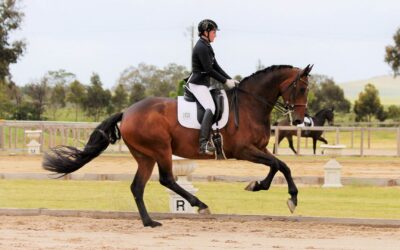
In walk your hands have to move, because the horse's head does. The hard part is that you cannot do it on purpose.
Watch: why soft wrists do the job that a busy hand cannot.
The short answer
The horse's head moves in walk, so your hands have to move with it. Not by giving the rein away, and not by holding it rigid. The movement comes from soft, supple wrists that keep the same contact throughout. Carry your hands as though you were holding two champagne glasses and did not want to spill them.
In this article
Start in halt, where everybody wins
Natasha opens this one standing still. In halt, can you keep your hands still? Hands up. Everybody can. We are all winners.
She then admits something most coaches would not: she used to enjoy riding in halt, because it was the only place she felt successful. The moment the horse started moving, the trouble started.
That is the whole problem in one image. Still hands are easy on a still horse. Everything after that is about what the horse's body does to your arms.
The question that answers it
Sit in walk, drop the contact entirely if you like, and watch the horse's neck in front of you. Does the head move in walk?
It does. It nods forward and back with every step, because the horse is using the neck to balance and to swing through the back.
So here is the question Natasha asks every rider, and it does most of the work:
If the horse's head moves in walk, does that mean our hands have to move in walk?
Yes. There is no other honest answer. A hand that stays fixed in space while the head travels is a hand that pulls and releases the mouth on every stride, whether you meant it or not.
This is exactly why walk and canter get different instructions. If you have read what to do with your hands in canter, you will have seen her say the opposite there: keep them still, locked in a little glass box. That is not a contradiction. It is the difference between a gait where the cause of your moving hands is the horse's neck, and one where it is your own body.
The two ways riders get this wrong
Almost everyone lands in one of two ditches, and Natasha has been in both.
The first is giving your hands away. The wrist goes floppy, the rein goes loose, and there is nothing to speak through. She describes coaches shouting at her, ride after ride: stop giving your hands away, stop giving your hands away.
So, being a good student, she solved it. She blocked them. Held them absolutely rigid so they could not be given away again. And you can see on the horse what that does: the neck jams up and the horse plainly does not like it.
Loose and rigid feel like opposites, and they produce the same thing. No conversation.
Soft wrists, not floppy and not fixed
The movement has to come from somewhere, and in walk it comes from the wrist.
Not a wrist that flaps, which gives that loose, disconnected contact. Not a wrist locked solid, which turns your whole arm into a pole. A soft, supple wrist that goes with the horse while the contact itself stays exactly the same.
The feel to aim for is not "my hands are moving". It is "I am staying in contact with the mouth", and the hands move as a consequence of that intention rather than as a thing you perform.
Why you cannot do it on purpose
In the lesson video, Natasha plays an alien who has just arrived and wants to know how this works. She has measured it, she says. She has worked out the answer. Two centimetres. Two centimetres, two centimetres, two centimetres, in rhythm, forever.
It is a joke, and it is also the point. Nobody can ride like that.
You cannot consciously go move, move, move, move. That would do all our heads in. It has to be a feeling.
Which is why the exercise below involves shutting your eyes rather than counting anything.
Try this in your next ride
Eyes closed, on the lead
- Have someone you trust lead the horse in walk. This one needs a person on the ground, not a phone on a jump wing.
- Take a light contact, then close your eyes. It feels alarming for the first few steps. Everyone reports the same thing.
- Stop trying to move your hands. Think only: I am staying in contact with the mouth.
- Notice where the movement is actually happening. Your wrist should be doing the giving and taking, not your whole arm swinging.
- Open your eyes and try to keep the same feel. That feel is the target, not a hand position.
Natasha's phrase for what you are doing here: getting into your body and out of your head.
The champagne glass test
Look down at your hands right now, in the saddle. If you were holding two champagne glasses, would there still be champagne in them?
Most riders look down and find their hands turned over, flat, knuckles up. Thumbs should be on top, wrists softly bent, as if each hand had a glass in it.
She is very open about how hard she found this. For years she rode with flat hands resting against the saddle, to the point that she wore the leather off it and had permanent bumps on her little fingers from the rubbing. Bending at the wrist felt impossible to her.
Walk is where you fix it, because walk is the easiest gait to think in. There is time to look down, notice, and correct.
While you are looking, check both hands are actually in the same place. Riders very often carry one hand further forward than the other and have no idea, which quietly makes one rein longer than the other.
Your hand starts at your back
One more thing worth understanding before you decide your hands are the problem.
Move your shoulder an inch. Watch what happened to your hand. When Natasha talks about contact she is not talking about a hand, she is talking about your back, your shoulder, your triceps, your biceps, your elbow, your wrist and your hand, all connected in a chain.
If I tighten my bicep, my hand moves a centimetre. And if your hand moves a centimetre, the horse feels it.
That is worth sitting with, because it explains why tension you are not even aware of turns up in the horse's mouth. It is also why a rider who tries to fix the contact purely at the fingers tends to go round in circles.
Watch it taught to a real rider
Same material, coached live, including the champagne hands, the even reins, and the moment the rider realises her hands were not level.
Watch: champagne hands, even reins, and playing with the outside rein.
The discipline almost nobody keeps
Here is the part that separates riders who progress from riders who stay where they are, and it is uncomfortable.
When you want the horse rounder, what do your hands want to do? They want to drop, or fiddle, or draw back. That urge is completely normal. And it works, in the narrow sense.
Natasha is straight about it: do that and yes, you will get the horse on the bit. If you have a test tomorrow, go ahead. But you will never get to the real connection, the one where the hind leg is doing the work.
The alternative takes more patience than most riders have:
I put my hands where I know they are meant to be, and everything feels really bad. But I know this is right, so my brain and my body have to figure out a way to get the horse round inside this frame.
You hold the correct shape and let it be awful for a while, and you make the rest of your riding solve the problem instead. The end point is a horse so connected that you can push your hand forward and it simply carries you.
One hand carried further forward than the other, which makes one rein longer without you choosing it. Look down in walk and check. Both hands in the same spot.
If you want the horse rounder or deeper, the work is in the outside rein and in your fingers, not in drawing the inside hand towards you.
Knuckles up, wrists locked, hands parked. Comfortable, and it removes the one joint that was supposed to be doing the following.
Walk is the easiest place to build all of this, which is exactly why it is worth spending time there. Get the hands right in walk and trot is next, because in trot the horse's head does not nod the way it does here, and the instructions change again.
If you want the whole picture, the seat, the alignment and the order the aids actually go in, Natasha teaches it in a free online dressage workshop.