Scared To Ride After A Fall? Watch What Happened To Jess
A fall, a concussion, an emergency c-section and more than a year out of the saddle. Then in one session she cantered, and gave me the second flying change of her life. Here is the whole thing on camera, including the detail that surprised me.
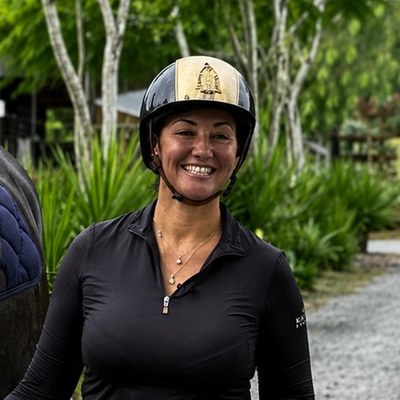
Watch part one: Jess and I sit down, before she has ridden.
The short answer
Fear after a fall is not nerves and it is not lost confidence. Your brain has quietly changed what it looks for. It stops selecting the thousand ordinary rides and starts selecting the one that hurt. That is why it does not fade with time, and why riding more often can make it worse rather than better.
In this article
It was not even her worst fall
Jess was twenty eight. She had a baby boy fifteen weeks old, an emergency c-section behind her, and she had not sat on a horse for over a year.
Her last ride had been on a green eight year old filly who, in Jess's own words, was good at playing tricks. She lost her balance, came off, and walked away with mild concussion.
Three weeks later she was still getting headaches and still feeling sick. That was when she took a pregnancy test and found out why.
Now here is the part that matters, and it is the first thing I went looking for when we sat down. When I coach a rider through fear I am listening for the evidence her brain is running on. And what came out of Jess's own mouth was this: that was not the worst fall she had ever had. She had come off harder before. And those times, she got back on.
If falling off were enough on its own to end a riding career, hers would have ended years earlier. Something else decided this one was different.
Sit with that for a second, because riders do something cruel to themselves with it. You compare your fall to somebody else's. You decide yours was not dramatic enough to justify how you feel about getting on. And then you quietly conclude that the problem must be you.
It is not you. The size of the fall was never what decided this.
What a year out of the saddle actually does
Jess had two things stacked on top of each other, and most riders reading this will have some version of the same stack.
The first was the fall. The second was the twelve months afterwards, when riding simply was not possible. Pregnancy, then a newborn.
Time off is not neutral. People assume a break lets fear settle and fade. It does the opposite. Every week you do not ride is another week your brain rehearses the one bad ride without a single ordinary ride to weigh against it. The pile of evidence only grows on one side.
Which is why "just give it time" is such well meant, useless advice. It came on its own. It does not leave on its own.
The puddle and the fire
I asked Jess what happened in her body when I said the words "we are about to get on the horse now".
Her stomach dropped. So I asked her what shape that feeling had, which sounds like an odd question until you have seen what it does.
She said: a puddle.
Then I asked about the other part of her. The part that says I know I can do this. She found that too, though she said it was very small. A little group of people standing in the cold, huddled around a tiny fire, with a puddle of water sitting there threatening to put it out.
That image was hers, not mine. I only asked the questions.
And there is the whole job, in one picture. Nobody needs to attack the puddle. You need to make the fire big enough that the puddle dries up on its own.
You do not have a fear problem. You have a fire that nobody ever taught you how to feed.
Why waiting to feel brave does not work
Most riders are waiting to feel ready. You will know the feeling. You are at the mounting block, or at the gate, waiting for something in you to shift so that getting on feels alright.
Here is what I said to Jess in the arena, and I stand by every word of it.
"Courage turns up after, when you do not need it. The party is over, dude. The party ended six hours ago. That is when courage turns up."
Courage arrives on the drive home. It is never there at the gate. So if your plan is to wait until you feel brave enough, you are waiting on something that has never once run to that timetable.
What you can change is what your unconscious is doing, which is the ninety nine per cent of this that you are not aware of. That is not a pep talk and it is not willpower. It is a different piece of work entirely, done off the horse, before you ever reach the gate.
It is also why trying to logic your way out of riding fear fails so reliably. You have almost certainly already told yourself that the horse is fine, that you have ridden for years, that none of this makes sense. Being right about all of that has not helped you once.
Five days later
This is Jess's first ridden session. Watch her face rather than her position.
Watch part two: walk, trot, canter, and a flying change.
She walked. She trotted. She cantered. Then she changed the rein across the diagonal and gave me a flying change, which was the second one she had ever done in her life.
Afterwards I asked whether she had expected any of it.
"I am not going to lie, I did not expect to get out of a walk. I was all prepared for walk was fine."
And then, about the canter down the long side:
"I was floating. Like I was flying."
I will be honest with you about why this video is public. It is not really to show you what I do. It is that moment on her face.
That bliss, that fun, that freedom. Jess had it once and lost it, and we handed it back to her in an afternoon. What keeps me awake is that there are riders who have never felt it at all. They know it exists, they can see it in other people, and they cannot find their way back to it.
Try this before your next ride
Try this before your next ride
Find the shape, then find the fire
- Somewhere quiet, and not at the stables, say out loud: "I am about to get on."
- Notice where your body answers. Most riders feel it in the stomach or the chest. Do not try to talk yourself out of it. Just find it.
- Ask what shape it has. Do not overthink it and do not reject the first answer, however odd it seems. Jess said a puddle.
- Now go looking for the other part. The one that knows you can ride, that has ridden for years, that has got back on before. It will feel much smaller. That is normal, and it is not a bad sign.
- Ask what that part would say if it were louder. Write the sentence down. That sentence is your fire, and writing it is the first log on it.
To be straight with you about what that is: a beginning, not a fix. It puts you in contact with the two parts that are actually having the argument. Making the fire big enough to dry the puddle takes a process, run in an order, and that is a bigger piece of work than one exercise on a page.
Three things that keep riders out of the saddle
The feeling does not come first. Riders who wait for it usually wait for years, and every month of waiting adds to the pile of evidence on the wrong side.
If nothing underneath has changed, more rides means more repetitions of the same braced, watchful ride. Some riders do get through this way. Many make it worse, and then blame themselves for that too.
The most common one, and the most unfair. Jess's was not her worst either. Severity was never the deciding factor, so measuring yourself against it tells you nothing except that you should feel ashamed, which is not true and does not help.
How long this actually takes
I want to be careful here, because Jess cantering five days after that first conversation is not the normal timeline, and I am not going to pretend otherwise.
Some riders move that fast. Others take a few weeks. A few take months, usually the ones carrying something older underneath the fall that has to be found first. What is consistent is the order of the work, not the speed of it.
What I will say is this. Almost every rider I meet has quietly decided that hers is the one that will not shift. Jess thought she was getting on and walking. If you have already decided you are the exception, that is worth noticing, because it is a very common thought and it is almost never true.
If any of this sounded like you, the free class below is where I teach the actual mechanism, including why most of this work happens off the horse.